The Adoption Gap
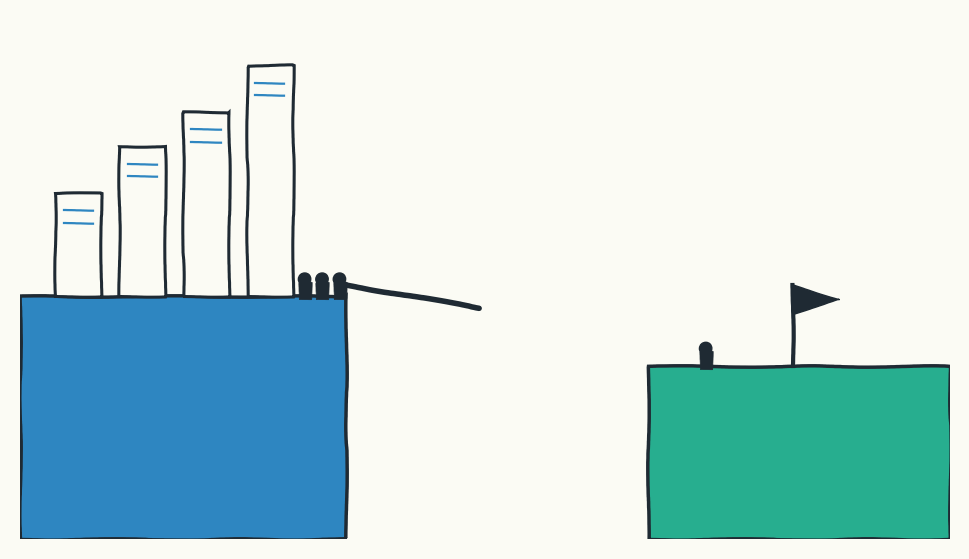
In its 2025 State of AI survey, McKinsey reported two numbers that, set side by side, describe the entire predicament. Seventy-eight percent of organizations now say they use AI in at least one business function. One percent believe they are mature in how they use it.
That second figure is neither a typo nor a survey artifact. Almost every large enterprise on earth has bought the technology, run the pilots, convened the steering committee, and issued the press release. Almost none can point to the result. More than eighty percent report no measurable effect on enterprise EBIT from generative AI. The average company has AI in roughly three functions, out of the thirty or forty a real enterprise actually runs. The expenditure is universal. The impact is not.
I have spent the last few months tracing where that impact goes missing, and a pattern surfaces that I find more instructive than the usual lament that "adoption is hard." The shortfall is not evenly distributed. It is not that AI works a little everywhere. It is that AI works rather well in a narrow set of places and barely at all across a much larger set of others, and the places where it falters are predictable in advance. I call the phenomenon the Adoption Gap: the distance, inside any given workflow, between what is now possible and what the enterprise has actually committed to production. I say possible rather than what AI can do because AI is not the whole of it. AI is the accelerant. Its deeper significance is how much adjacent technology it has abruptly dragged into reach, the process mining nobody could interpret, the automation that shattered on every exception, the integration that used to require a developer, the analysis that used to require a data scientist. AI is the interface that makes the rest usable, and so the gap is really the distance between total available capability and deployed capability, widened overnight on the available side. The premise of this publication, and of everything that follows it, is that the gap is widest precisely where the stakes are highest, and narrowest in the functions that supply all the demos.
A word on remit before the argument, because it matters. The Adoption Gap is a lens, not a list. It opens wherever someone has failed to join the pieces, and that includes the lagging functions I will dwell on below, but also the newly shipped model nobody has yet embedded in a process, and the cross-functional use case whose value lies in connecting two systems that have never spoken. The most interesting territory is rarely a single department. It is the seam between them.
Where the gap closes on its own
Begin with where AI already works, because it explains everything else. Software engineering has copilots in nearly every editor. Marketing has generation woven into every surface it touches. Customer service runs deflection and agent-assist in production at scale. These functions adopted quickly for reasons that have nothing to do with their importance and everything to do with their shape. The work is high in volume and repetitive in character. The output is low enough in stakes that an error is cheap to catch. The data resides in a handful of modern systems. And decisively, the person wielding the tool is usually the person who benefits from it, so adoption requires no permission.
That is the anatomy of a function where the Adoption Gap collapses without intervention. Invert those properties and the gap yawns open. This inversion is the part worth naming, because it forecasts where the unclaimed value sits.
The four properties that hold a function back
The workflows with the widest Adoption Gap share four traits, and they tend to exhibit all four at once.
They are document-heavy: the substance of the work is reading, construing, and producing dense text, contracts, regulations, policies, audit evidence, incident narratives. They are decision-heavy: the output is a judgment that carries consequence, an award, an opinion, a control rating, a public disclosure, not a draft email. They are control-heavy: the function exists in part to constrain the rest of the business, so its own errors are costly and its tolerance for a confident falsehood approaches zero. And they are operationally fragmented: the information needed to do the work is dispersed across legacy systems, spreadsheets, inboxes, and institutional memory, with no trusted layer to point a model at.
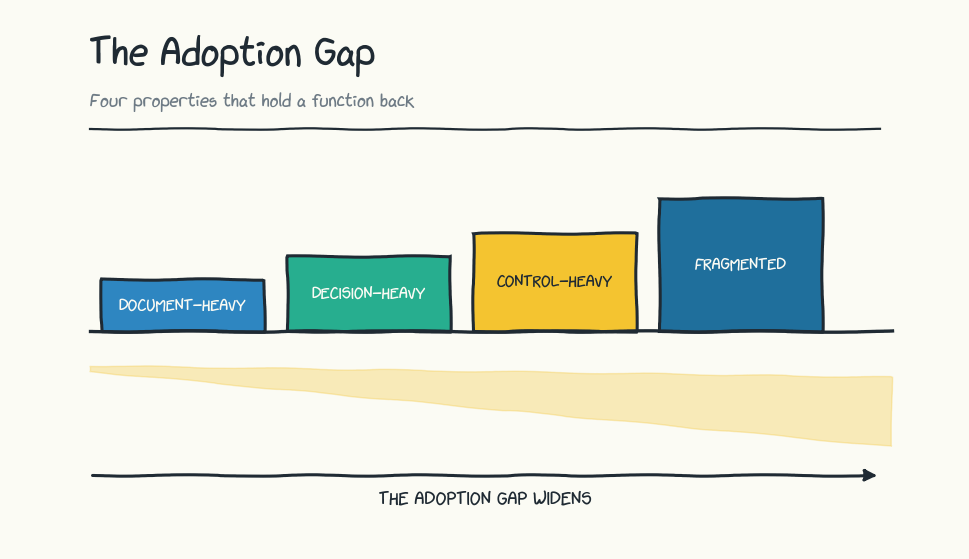
A function bearing one of these traits adopts slowly. A function bearing all four ossifies. And when I pass the enterprise org chart through that filter, the same candidates surface every time: procurement and sourcing, regulatory compliance, legal and legal operations, internal audit, quality management, environment-health-and-safety, sustainability and ESG reporting, the project management office. These are not the functions anyone parades at a conference. They are the functions that actually govern the company.
The evidence, function by function
Let me be concrete, since specifics over generalities is the discipline this publication holds itself to.
Procurement is the single largest opportunity I can locate, and the cleanest illustration of the gap. Deloitte's 2025 Chief Procurement Officer survey bifurcates the field. Its "Digital Masters" report sixty-two percent generative AI deployment and a 2.8x average return on the investment. The followers report fifteen percent deployment and a 1.6x return, and roughly half of them are either merely contemplating the technology or have no plans to assess it at all. Identical function, identical use cases, divergent outcomes, and the variable is not the model. Jabil, working with Coupa's sourcing optimization, excised a month from its sourcing cycle and saved nine million dollars. A 2026 Forrester study commissioned by Zip modeled a 386 percent return and 5.8 million dollars in net present value for a composite enterprise running AI procurement orchestration. The value is real and documented. Most procurement organizations have not captured a cent of it.
Regulatory compliance follows immediately behind. KPMG characterizes adoption as still in its early phases, and the data corroborates the characterization: fifty-six percent of compliance teams reported using AI in 2024, up from forty-one percent the prior year, but the usage is shallow and scattered across policy drafting, training, and change tracking rather than embedded in how the function operates. Compliance is nearly a perfect specimen of the four traits. Its core task is the translation of regulatory text into operational control, which is document-heavy and decision-heavy by definition, and its entire reason for existing is constraint.
Legal exposes the widest chasm between appetite and action. Thomson Reuters found that eighty-nine percent of professionals perceive a use case for generative AI in their own work and seventy-one percent of corporate legal respondents believe it ought to be used. Only twenty-five percent report wide-scale rollout. More than half operate without a formal AI policy and nearly two-thirds have received no training. The tools recover real time where deployed: Thomson Reuters estimates the latent saving at close to 240 hours per lawyer per year, Brink's used CoCounsel to sustain a legal footprint across fifty-four countries while compressing outside counsel spend, and the Financial Times reported Unilever's in-house team reclaiming roughly thirty minutes per lawyer per day. The constraint is not conviction. The constraint is governance, and the penalty for getting it wrong is vivid: courts have already sanctioned lawyers for filing briefs studded with hallucinated citations, exactly the species of confident error a control-heavy function cannot absorb.
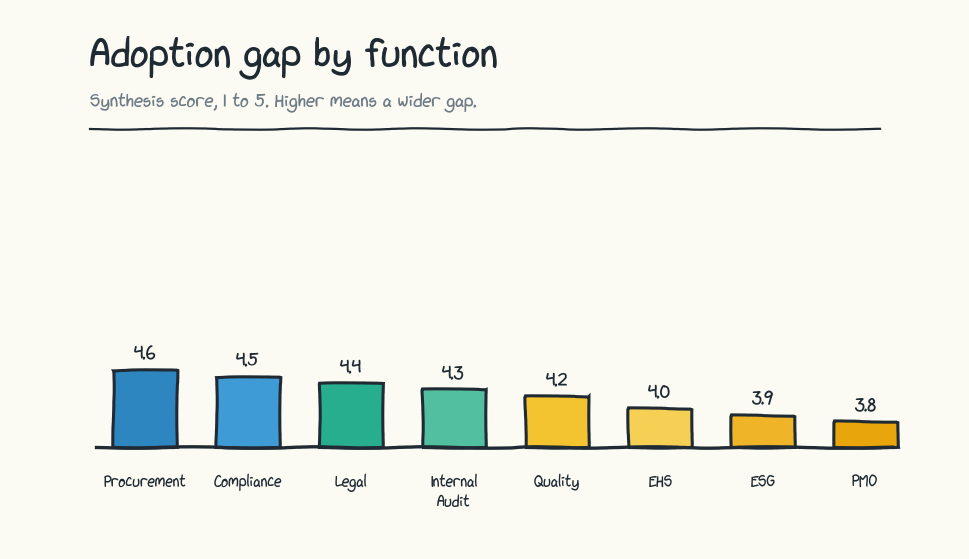
The pattern persists down the roster. Internal audit: thirty-nine percent using AI, yet forty-six percent concede the function trails the rest of their own business, and fewer than forty percent feel equipped to detect AI-enabled fraud. Quality management: striking documented results where deployed (Lenovo eliminated roughly half its preventable rework and cut rework cost sixty percent with Instrumental, GE's vision systems surfaced 150 percent more defects than human inspectors), yet adoption languishes in complex manufacturing because the local return reads as uncertain even when the technology is demonstrably more accurate. EHS: a mere eleven percent of safety functions are fully digitalized and seventy-one percent still run hybrid manual processes, which means the data layer a model would require largely does not yet exist. ESG reporting: only thirty-six percent of sustainability teams claim high-quality data for AI, and two-thirds lack the governance to wield it safely. The PMO is the laggard among laggards: twenty-one percent using AI, half with negligible experience, more than forty percent without any training.
Eight functions, one silhouette. High potential, low maturity, held back by the identical four properties.
Why the gap is the opportunity
Here is where I part company with most coverage of enterprise AI. The Adoption Gap is conventionally framed as a failure, a parable of squandered budget and disenchanted boards. I read it as the inverse. A closed gap is a commodity. The functions where AI already works are functions where your competitor's AI also already works, and whatever advantage existed has been arbitraged away. The open gap is where advantage still resides. A 2.8x return against a 1.6x return in procurement is no rounding error. It is the entire distance between a Digital Master and a follower in the same market, and it is available to whichever organization closes its own gap first.
The gap, moreover, yields to a knowable sequence, one that inverts what most failed programs attempt. The failures open by chasing autonomy, the end-to-end agent that supplants the function. The successes open narrow.
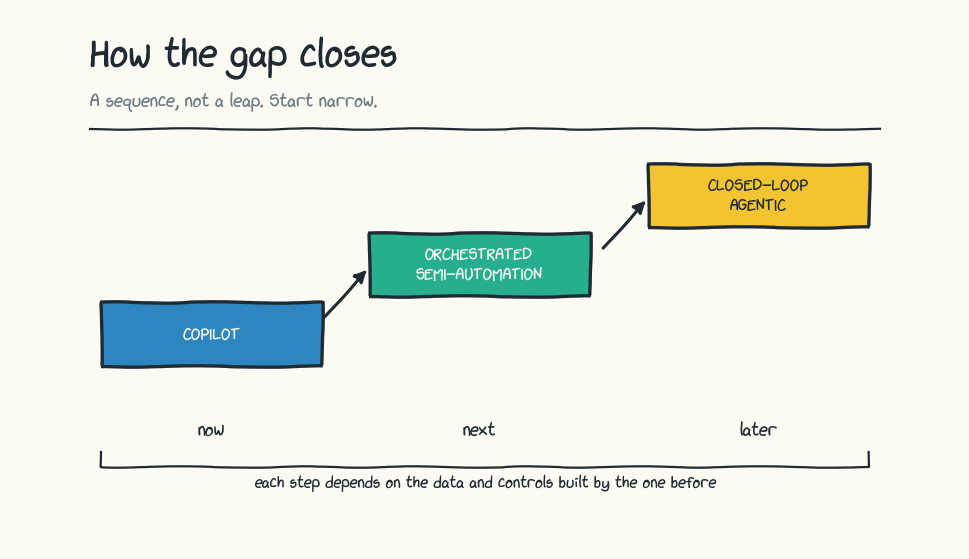
First, workflow copilots inside one bounded, high-friction task, drafting an RFx, summarizing a contract, screening an exception, with a human ratifying every output. Second, orchestrated semi-automation, once a trusted data layer exists, in which the model routes and prepares work across the function while a person still approves anything consequential. Third, and only third, closed-loop agentic execution, where the system acts and the human supervises by exception. Nearly every stalled program I can find attempted to begin at the third step. Nearly every documented success began at the first and earned its way forward.
What this means on Monday
If you run one of these workflows, the practitioner move is not to commission another strategy deck. It is to select a single task this week, document-heavy, repetitive, and presently slow, and stand up a copilot for that one task with a human in the loop and a baseline metric fixed before you begin. Not the function. One task, instrumented. In procurement, RFx drafting or contract summarization. In compliance, obligation extraction from incoming regulation. In legal, grounded research with mandatory citation verification. In audit, control-narrative extraction and deterministic exception screening. The cross-cutting hazard in every instance is identical, and it is blunt: the thing that kills these projects is almost never the model. It is impoverished data, ill-designed workflow, absent oversight, and ambiguous ownership between the function and IT. Resolve those, on one task, and you possess a template for the whole.
That is the work this publication exists to perform, and it does not stop at the eight functions above. Wherever capability has outrun deployment, there is a gap worth closing and an article worth writing. In practice that means a great deal of ground. The tool that shipped last week and the workflow it belongs in but has not reached. The open-source project buried three pages deep on GitHub that quietly does what a six-figure platform charges for. The failed experiment dissected honestly, because the post-mortems nobody publishes are worth more than the case studies everybody does. The stack choice argued on its merits instead of its marketing. The architecture stripped down and drawn plainly enough that you could hand the diagram to your team on a Tuesday and they would know what to build. The connective tissue, in other words. The imagining.
Because that is the genuine scarcity. The capability is abundant and cheapening by the month. What no operator has is the time to read every release, test every tool, trace every integration, and picture how the pieces assemble into something that actually works inside their own walls. I intend to do that imagining on your behalf, in the open, and to be concrete enough that you can act on it Monday rather than admire it Friday. I will begin with procurement, because it is the largest gap I can find, and proceed wherever the territory rewards the attention. The Adoption Gap is the largest unclaimed advantage in the enterprise today. I mean to show you, precisely and repeatedly, how to close yours.
Comments ()